RBD can be seen as a new philosophy in which demolition and the waste it creates is seen as a design flaw. The intention of RBD design is to design for circular value chains. This means that design should ensure multiple reuse options for the building, its systems, products, components and materials, and provide incentives to maintain or increase the value of the building through reuse, repair, reconfiguration or remanufacturing. Different scenarios for the reuse and transformation of buildings, systems, products and materials will result in different business/financial models that will reduce the risk of future vacancy and poor technical performance. Renting space is already a well known concept in real estate, but as a result of RBD, renting building systems, products, components and materials or their performance will introduce new business concepts (product service systems or take-back systems).
When exploring the concept of RBD, three dimensions of reversibility within a building can be identified, namely (1) spatial, (2) structural and (3) material reversibility. The reversibility of these dimensions is accommodated by transformative actions such as the ability to separate, eliminate, add, relocate and substitute elements of the system without demolition (Durmisevic 2006). As such, these dimensions determine the level of spatial transformation (first dimension), structural transformation (second dimension) and material transformation (third dimension). RBD tools help designers to understand the reversibility potential of their designs, manufacturers to develop reversible and circular products, owners to gain a better understanding of the whole life value of the asset, contractors to develop reversible construction methods and demolition contractors to gain a better understanding of the composition of buildings and their potential for reuse.
When building design integrates all three dimensions of reversibility into the final design solution, high value recovery on all three levels can be expected throughout the life cycle of the building and its systems and materials. RBD tools will enable the three dimensions of transformation (and associated benefits) within the building. Two key indicators of Reversible Building Design and dimensions of reversibility are the transformation capacity and the reuse potential of the building and its structure (at all levels: building, system, product, element). Ultimately, reversible building is a result of high reuse and transformation potential of the building.
Both indicators depend on design for disassembly capacity and together (disassembly, transformation/adaptability and reuse) form the core of reversible buildings.
In this respect, design for disassembly can be seen as a key element of RBD, allowing for easy modification of spatial typologies and high value recovery of building systems and components without damaging either. Furthermore, the assessment of disassembly aspects, which addresses both indicators of reversibility (1) adaptability and (2) reusability, contributes to the understanding of the level of reversibility of buildings. Low disassembly potential will lead to low reversibility and vice versa.
Ultimately, disassembly, adaptability and reuse form the core of building reversibility and as such determine the level of spatial, structural and material dimensions of reversible buildings. They can therefore be mobilised to evaluate buildings, but also to guide the design process towards more reversible solutions by becoming part of the Reversible Building Design Protocol.
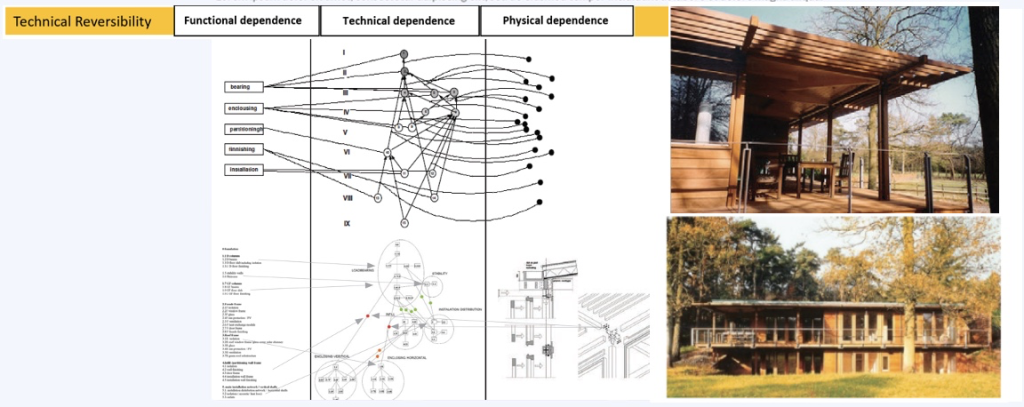
In addition, two key indicators of building structure reversibility are independence and interchangeability of building systems/components. Independence mainly addresses functional independence and creates an environment where assembly, transformation and disassembly of one functional cluster can be realised without affecting the other.
Interchangeability addresses technical and physical independence and creates an environment in which systems/components/elements can be disassembled without damaging surrounding parts of the structure and provide potential for their reuse in other contexts. The number and hierarchy of physical relationships and interface typologies that increase the potential for reuse are essential.
In order to design reversible structures that encourage a conscious use of raw materials and provide a high level of transformation and reuse, the following requirements should be met.
- Accessibility,
- Variation,
- Reuse,
- Replaceability and refurbishment
- Reconfiguration, and
- Recycling
A structure is reversible if its elements/components/systems are defined as independent parts of a building structure and if their interfaces are designed for interchangeability. Independence of parts is primarily determined by functional design domains dealing with the design of material levels of the technical composition of the building and the specification of independent material clusters.
The interchangeability of parts is mainly defined by technical and physical design domains that deal with the hierarchical arrangement of elements within structures and with connections between elements.
